

What the two numbers mean
Watt-hours describe nominal stored energy. A distance describes an outcome under a set of conditions. Wheels, speed, load, stops, gradients, weather and battery condition affect the relationship. A battery capacity can be verified without measuring how far a rider will travel.
For example, the Ultra Hub’s 216Wh and 345.6Wh configurations use the same listed wheel size. The 60% capacity increase is an exact calculation from the labels. Turning it into 60% more distance would require comparable real riding information that the capacity labels do not provide.
A transparent calculation, with its limits
Watt-hours can be estimated from nominal voltage multiplied by amp-hours when those ratings describe the same battery. Do not multiply amp-hours by the fully charged voltage and call the result nominal energy. Series count, cell capacity and the manufacturer’s rated value need to be kept consistent.
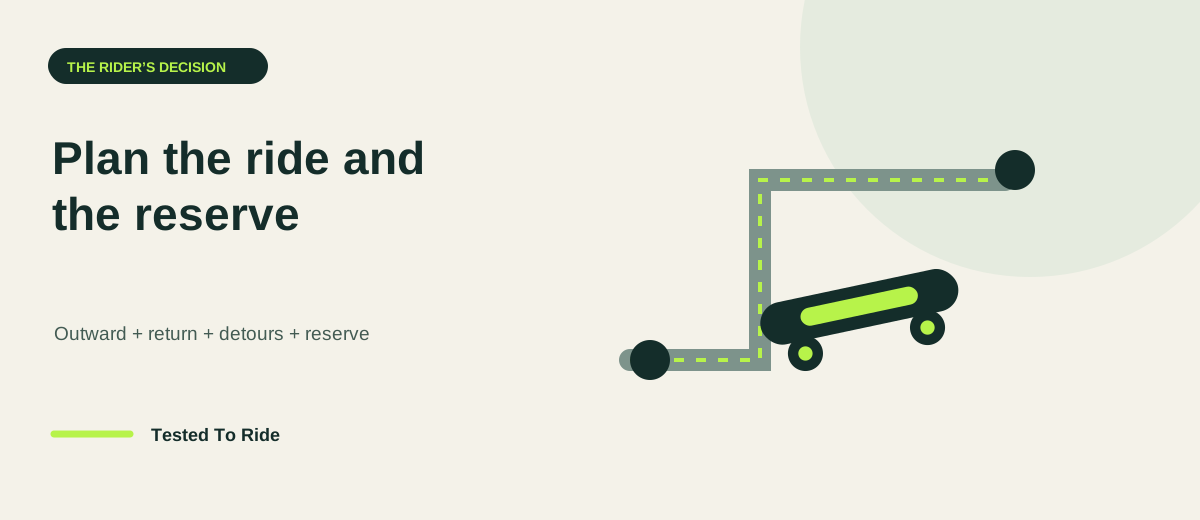
For a trip example, an 8-mile one-way route ridden twice, a 1-mile detour allowance and a chosen 3-mile reserve produce a 20-mile requirement. Changing the form to kilometres converts entered distances rather than change the journey. None of those inputs supplies a consumption rate or proves a board’s achievable range.
A measured partial ride is useful on its own terms: record its distance, battery endpoints, mode and conditions. Do not extrapolate a precise full-charge distance from a coarse remote percentage without explaining the uncertainty and method.
Read the conditions attached to a result
A useful record identifies the exact battery, wheels, drivetrain and revision; rider and carried load; distance method; starting and ending battery levels; speed/mode; route and surface; temperature and wind. Missing conditions weaken a comparison even when the mileage is precise.
A trip ending with battery remaining establishes that trip, not a measured full-range result. A remote’s remaining bars also do not automatically provide a linear usable-energy gauge. Keep a rider’s described outcome separate from an extrapolated estimate.
What makes two range accounts comparable?
- The same battery option and supplied or changed wheel setup are identified.
- Rider and carried equipment, route elevation and surface are described.
- Speed, mode, stops and temperature are recorded sufficiently to understand the trip.
- Start and end battery levels and the distance measurement method accompany the result.
- The account says whether the ride ended voluntarily, at a warning or at another defined endpoint.
When one of those differs, explain how it limits the comparison instead of correcting the result with an invented percentage. A pneumatic board and a smaller-wheel street setup can have very different demands even with similar nominal energy.
For an essential journey, build confidence through your own permitted trips with a fallback and the manual’s instructions. The longest advertised number is a poor target for arriving with no alternative.
Calculate the distance requirement
Add the required legs of the journey, detours and a reserve you explicitly choose. The planner below performs only that addition; it does not use pack size to predict range. Use one distance unit throughout and a relevant documented result before deciding that a board meets the resulting requirement.
As a planning example, two four-mile legs plus one mile of detours and a two-mile reserve require eleven miles of credible coverage. Those are entered assumptions for an example trip, not a tested route or a universal reserve recommendation.
Your trip requirement
Requirement = one-way distance × journey legs + detours + chosen reserve. The equation works without the interactive form; it does not predict what any board will achieve.
When arrival matters
For a fixed appointment or work shift, identify where you could stop, charge with permission or switch transport. Check the return conditions too; wind, temperature or the carried load may change during the day. A longer manufacturer headline should not replace that contingency.
Use the commuting guide to account for carrying and storage. For recreation, choose a loop and fallback you can manage rather than extend the outing until a battery warning creates the plan.
What I would ask before a range-led purchase
Ask which exact configuration produced the stated distance, at what load, speed and conditions, and to which battery endpoint. For a removable-pack product, establish whether the claim uses one module or a swapped second pack. For an AT family, keep street-wheel distances out of the pneumatic comparison.
Then compare the practical pack upgrade with its mass, charging and parts requirements. The longer-route buying guide narrows those choices without creating an invented real-world range chart.
Questions about this task
Can I convert 345.6Wh into miles directly?
No. You need a credible energy-consumption figure for the actual board, rider and conditions before converting watt-hours into distance. A 345.6Wh label establishes nominal stored energy, not a universal number of miles.
Does the range calculator predict board performance?
No. The calculator adds your trip legs, detours and chosen reserve. It gives the distance you need to cover; it does not estimate a board’s battery consumption or promise that a particular model can finish it.