

Tynee Ultra Belt
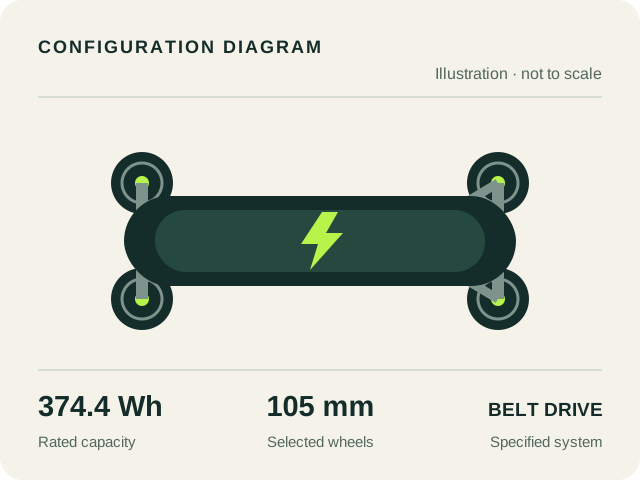
Its 374.4Wh pack and belt platform deserve a joint decision. Compare the energy gain, consumables and desired wheels instead of treating the battery figure as the whole upgrade.
13S · 374.4Wh · 105mm 72A wheels
Tynee Ultra X Pro
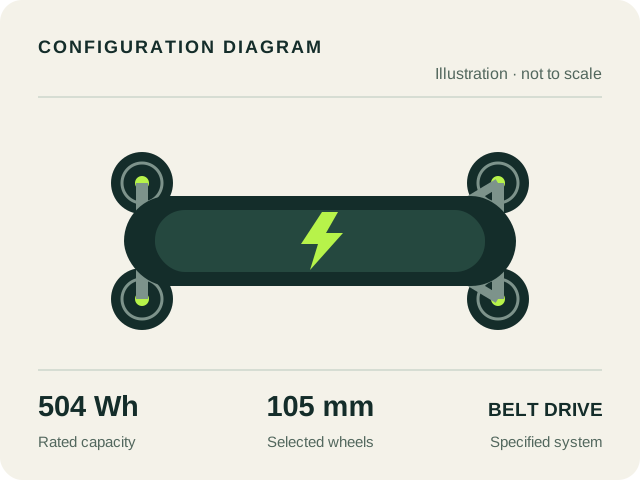
The selected 504Wh belt/LED board is a more substantial pack step. The listed 10.35kg and exact charger revision belong in the plan alongside capacity.
belt drive · LED deck · 504Wh · 105mm
The tradeoff, made visible
Explore the specification tradeoffs
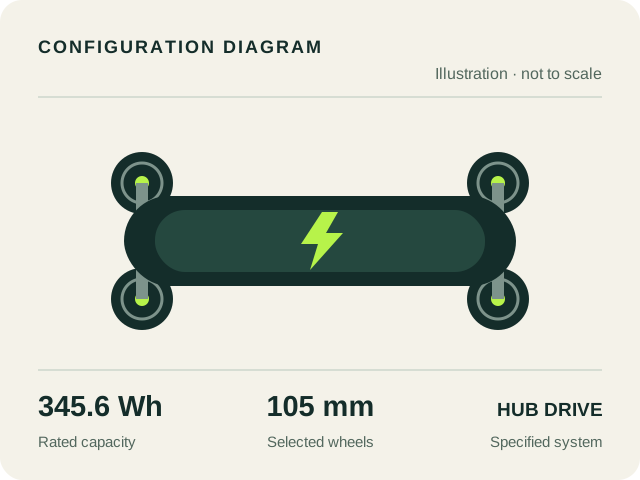
- Tynee Ultra Hub — 345.6Wh345.6 Wh
- Tynee Ultra Belt374.4 Wh
- Tynee Ultra X Pro504 Wh
- Tynee Explorer864 Wh
- Ownboard Carbon Zeus Pro936 Wh
- Acedeck Nomad N3 Elite1554 Wh
Rated battery capacity in watt-hours. Stored energy is not a measured distance or a prediction of range.
Start with a distance you need to finish
Count the complete journey, likely detours and whether charging at the destination is genuinely permitted and practical. An occasional long recreational loop and a fixed arrival-time commute create different consequences for running short. Make a fallback plan before treating a headline range as a transport guarantee.
The manufacturer range column on the homepage retains attributed claims with model-specific limitations. Those claims use different conditions. We do not have a controlled same-route comparison that establishes a longest-range winner among these configurations.
Use capacity to narrow the options
A sensible street comparison begins at 345.6Wh for the larger Ultra Hub, 374.4Wh for the Ultra Belt and 504Wh for the selected Ultra X Pro. These are configuration facts. The drivetrain, wheel system and load can change consumption, so equal watt-hours are not equal miles.
There is a useful small upgrade distinction here: 374.4Wh is about 8.3% above 345.6Wh, whereas moving from 216Wh to 345.6Wh is a 60% nominal increase. The first comparison also changes drivetrain; the second retains the Ultra Hub’s 105mm wheels. Neither calculation predicts the percentage change in your trip distance.
Choose the smallest change that meets the longer-route brief
Start by asking whether the existing wheel type and carrying envelope should remain. The larger Hub retains 105mm wheels and lists 9.0kg; the Ultra Belt changes the drive and has 374.4Wh; the selected belt/LED Ultra X Pro reaches 504Wh and a listed 10.35kg. Those differences describe progressively different ownership packages, rather than a simple miles-per-dollar ladder.
A move from the larger Hub to Belt adds only 28.8Wh nominal energy. I would want a wheel-system or drivetrain reason for that move, rather than describe the small capacity step as a transformative distance upgrade. The X Pro’s higher-voltage charger and different parts must also fit the charging and maintenance plan.
For the final decision, write the route requirement beside the exact configuration and a relevant riding record. If only manufacturer figures are available, treat the remaining uncertainty as a reason to preserve a fallback, not as an invitation to convert watt-hours into an invented trip distance.
A larger pack may change the platform
The Explorer’s selected 864Wh pneumatic setup and Zeus Pro’s 936Wh AT kit move the comparison into different wheel and storage requirements. They should be chosen for a suitable specialist brief, not appended to a street shortlist solely because their packs are larger.
The current Nomad N3 Elite advertises 1554Wh, but its exact delivered batch, drive, mass and box need confirming. I would keep it a conditional specialist until those ownership details are settled. A large pack number does not answer whether a board can be carried, serviced or used on the intended route.
A 70km range requirement needs more than a large pack
Seventy kilometres is about 43.5 miles. If you need that from a single charge, the current research does not establish a controlled exact-configuration winner for the requirement. A maximum family range headline, particularly one achieved on different wheels, would not settle the purchase.
There are several ways to change the brief: divide the journey with a permitted charging stop, use an approved removable-pack system, shorten the route or choose another transport plan. Each changes equipment, time or logistics. It should not be hidden inside a claim that the board itself has a proven 70km range.
The Explorer illustrates the wheel problem: its manufacturer advertises different distance figures for pneumatic and street wheels. The selected 175mm AT order cannot borrow the street configuration’s longer figure. Apply the same discipline to premium family names, cell choices and auxiliary packs.
Count the charging arrangement
Identify the charger included in the exact kit, its mains requirements and the endpoint used for a charge-time claim. An optional high-power charger should not lend its charging headline to a base package. Access to a socket is also different from permission to charge and the ability to attend the charge.
A spare battery can be useful on a platform designed for approved swapping, but it adds equipment and another charging task. Compare that whole routine against an integrated larger pack rather than assuming a two-pack range total belongs to one installed module.
What would change my recommendation
A documented trip with the same wheels, relevant rider load, route profile, speed and weather is more useful than an unsupported exact-mile estimate. Keep start/end battery levels and the distance method attached to the account. A partial ride establishes that trip, not necessarily a measured full depletion range.
Use the range planning worksheet to record the missing conditions. I would buy around an essential route only once the required distance, reserve and backup plan are credible for the exact setup.
Horizon Elite: capacity with a substantial carrying burden
The Acedeck Horizon Elite with independent suspension, 2072Wh Samsung 50S pack and no bindings is a much larger specialist. Its maker lists 28.65kg / 63.2lb and overall dimensions of 1140 × 470 × 230mm, about 44.9 × 18.5 × 9.1 inches. The selected package includes a 58.8V/9A charger; bindings cost extra.
I would consider this platform only when the terrain, storage and transport plan justify that mass. The catalogue marks Elite orderable but the US 1554Wh selection unavailable. Two 1036Wh versions remain in a specification table without selectable offers. None supplies a measured long-distance result for this guide, and a larger pack does not make a 63lb board a practical station-transfer choice.
Compare exact packs and their range limitations
| Board | Selected kit | Rated capacity | Listed board mass | Range basis | Amazon |
|---|---|---|---|---|---|
| Tynee Ultra Hub — 345.6Wh | 345.6Wh EVE / 105mm donut wheels / six-month base warranty | 345.6 Wh | 9 kg / 19.8 lb | Maker claim up to 23 miles for 345.6Wh. Conditions not fully isolated; no measured range result. | Find on Amazon Search results; this exact kit is not verified on Amazon. |
| Tynee Ultra Belt | 13S · 374.4Wh · 105mm 72A wheels | 374.4 Wh | 8.6 kg / 19.0 lb | Maker claim up to 31 miles. Nominal energy does not establish route distance. | Find on Amazon Search results; this exact kit is not verified on Amazon. |
| Tynee Ultra X Pro | belt drive · LED deck · 504Wh · 105mm | 504 Wh | 10.35 kg / 22.8 lb | 504Wh belt/LED kit; do not use a gear-drive or older-pack result. | Find on Amazon Search results; this exact kit is not verified on Amazon. |
| Tynee Explorer | US 864Wh Samsung 50S · 175mm pneumatic quick-release wheels | 864 Wh | Confirm 864Wh kit | Maker AT claim up to 36 miles; the 52-mile street-wheel claim is a different setup. | Find on Amazon Search results; this exact kit is not verified on Amazon. |
| Ownboard Carbon Zeus Pro | US · Samsung 50S 936Wh · six-inch pneumatic AT | 936 Wh | Variant-specific: confirm | 936Wh / 6-inch pneumatic configuration. Cell and wheel options must stay matched. | Find on Amazon Search results; this exact kit is not verified on Amazon. |
| Acedeck Nomad N3 Elite | US Elite · Samsung 50S · 1554Wh · 6485 motors | 1554 Wh | Confirm current Elite | 1554Wh Elite selection; exact delivered build and mass unresolved. | Find on Amazon Search results; this exact kit is not verified on Amazon. |
Questions about this shortlist
Which pack would I compare first for a longer street ride?
I would start with the Ultra Hub’s 345.6Wh/105mm configuration for a longer street route. It retains the supplied wheel size at a listed 9.0kg. Confirm that the actual journey is realistic; extra capacity is not a guaranteed mileage figure.
Why not name the largest battery as best?
Because the largest pack can come with an unsuitable size, mass or service burden. The N3 Elite’s 1554Wh headline leaves its exact delivered configuration and carrying questions unresolved. Those details can disqualify it even when nominal capacity is the priority.