

Tynee Ultra Belt
13S · 374.4Wh · 105mm 72A wheels
The tradeoff, made visible
Explore the specification tradeoffs
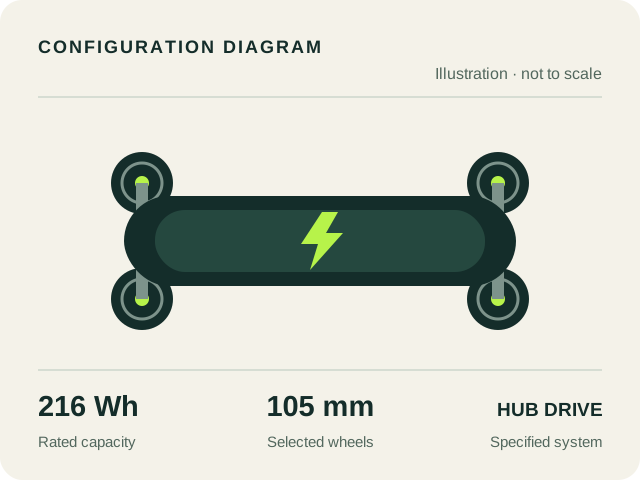
- Tynee Ultra Hub216 Wh
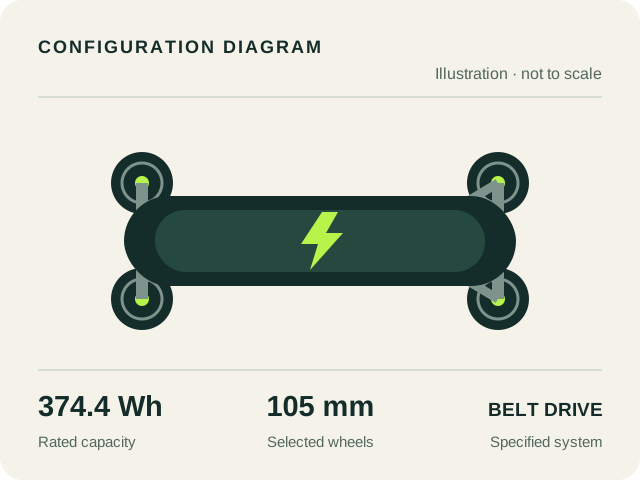
- Tynee Ultra Belt374.4 Wh
Rated battery capacity in watt-hours. Stored energy is not a measured distance or a prediction of range.
Set the baseline before comparing
This comparison uses the 216Wh/105mm/six-month Ultra Hub and the 13S 374.4Wh/105mm Ultra Belt. The Hub also has a 345.6Wh option, and older Ultra descriptions use other batteries. Keep those choices separate when matching a price or charger.
Both selected base boards have a manufacturer-listed mass of 8.6kg. Equal listed mass makes the capacity difference worth examining, but it does not establish identical deck feel, handling or carrying comfort.
Compare capacity before deciding what an upgrade is worth
The Belt’s 374.4Wh is about 73.3% more nominal energy than the 216Wh base Hub. That is specification arithmetic, not a measured range advantage. Compare the selected seller kits with their included chargers, remotes and warranty terms before judging the extra purchase cost.
The larger Hub selection is a useful third configuration: 345.6Wh at a listed 9.0kg. Against that option, the Belt adds about 8.3% nominal energy and changes drivetrain. Decide whether the drive and wheel arrangement is the reason to pay more.
Put the larger Hub beside the Belt
For a buyer who wants more energy rather than a belt system, the larger Hub is the important third option. Moving from its 345.6Wh pack to the Belt adds 28.8Wh nominal capacity. That is a much narrower energy difference than the comparison with the 216Wh base suggests.
The larger Hub lists 9.0kg, while both selected base Hub and Belt list 8.6kg. I would not use the apparent Belt advantage to promise easier carrying: shape, balance and the lift still matter. It does, however, prevent the mistaken assumption that every larger battery configuration has the same mass penalty.
Choose the Belt for the supported transmission and wheel plan you want. If you will keep the supplied wheels and do not need that plan, compare the larger Hub’s total ownership cost before treating belt drive as a compulsory upgrade.
Which ownership routine fits you?
Hub drive keeps exposed belts out of the service list but depends on the correct driven sleeves. The Belt adds belts, pulleys and alignment/tension tasks while offering the supported belt-wheel system. Obtain the actual parts and procedures for whichever route you choose.
Do not compare generic upgrade possibilities as though every wheel fits. Confirm pulley standard, clearances and control settings for a proposed change. If you plan to keep the supplied wheel setup, explain why the extra hardware is still useful to your route.
The Belt includes its first spare pair
The Ultra Belt’s 40T Kegel pulley setup uses 5M265 belts with 15mm width. Two spare belts are already included. Tynee’s four-pack, SKU Four-5M265-Belts, supplies two additional replacement pairs; it is optional stock rather than an extra required to start riding.
The 105mm Ultra Hub uses a different replacement system. Its matching Tynee Donut set contains two rear donuts and two front wheels. The separately listed hub-sleeve pair is 90mm, so it is not a same-size replacement for that 105mm setup. Those orders cover different jobs and quantities; compare the current cost of the correct parts rather than treating one pack as a yearly maintenance bill.
Treat the electrical systems separately
The Hub is a 12S system with a 50.4V charge ceiling; the selected Belt is 13S with 54.6V. Those chargers are not substitutes merely because a connector looks familiar. The actual approved charger and mains label belong with the selected battery.
The Belt’s stated three-hour charge window is a manufacturer claim for its setup. A controlled comparison would need actual starting levels, endpoints and chargers. I would not choose a winner for charging convenience from an unmatched headline.
My decision rule
Choose Hub when the base or larger-pack configuration meets the route and the supported sleeve system fits your upkeep preferences. Choose Belt when the capacity and wheel-system benefits are worth the additional consumables and purchase amount. Reconsider either if the board cannot be carried or stored where required.
For a first purchase, compare the learning requirements too. The drive-system guide covers the broader service questions without turning this pair into a universal hub-versus-belt result.
Compare the ownership systems
| Board | Selected kit | Rated capacity | Listed board mass | Drive and service | Amazon |
|---|---|---|---|---|---|
| Tynee Ultra Hub | 216Wh · 105mm donut wheels · six-month base warranty | 216 Wh | 8.6 kg / 19.0 lb | 12S / 50.4V charge ceiling. Matched 105mm replacement set has two rear donuts and two front wheels. | Find on Amazon Search results; this exact kit is not verified on Amazon. |
| Tynee Ultra Belt | 13S · 374.4Wh · 105mm 72A wheels | 374.4 Wh | 8.6 kg / 19.0 lb | 13S / 54.6V charge ceiling. 40T Kegel / 5M265-15mm belts; two spare belts included. | Find on Amazon Search results; this exact kit is not verified on Amazon. |
Questions about this comparison
Would I buy Belt just for the bigger battery?
I would compare the 345.6Wh Hub first if capacity were my only reason to upgrade. The Belt’s 374.4Wh is only about 8.3% more nominal energy than that option. I would choose Belt for a useful transmission or wheel-system benefit as well.
Can these boards share a charger?
No. The selected Hub is 12S with a 50.4V charge ceiling; the Belt is 13S with 54.6V. Use each board’s approved charger. A shared brand or similar plug does not make those systems interchangeable.