

Follow the power path
Open up the ownership question
Hub
Check sleeve diameter, material, motor compatibility and replacement supply.
Belt
Confirm belt pitch, width and length, pulley teeth, wheel core and clearance.
Gear
Ask for the service procedure, specified parts and support for the selected transmission.
Hub drive: inspect the motor-wheel system
On a hub board, the motor is part of the driven wheel assembly. The Ultra Hub and G2 Black are relevant examples, but their sleeves and electronics are model-specific. Replacing an ordinary front wheel and replacing a motor sleeve are different compatibility questions.
The attraction is a drivetrain without an exposed belt to tension or replace. The compromise is dependence on suitable motor sleeves and supported assemblies. Ask for the actual sleeve size, hardness options, fitting instructions and replacement supply. Low external upkeep should not be described as zero maintenance.
Belt drive: choose the wheel system and consumables
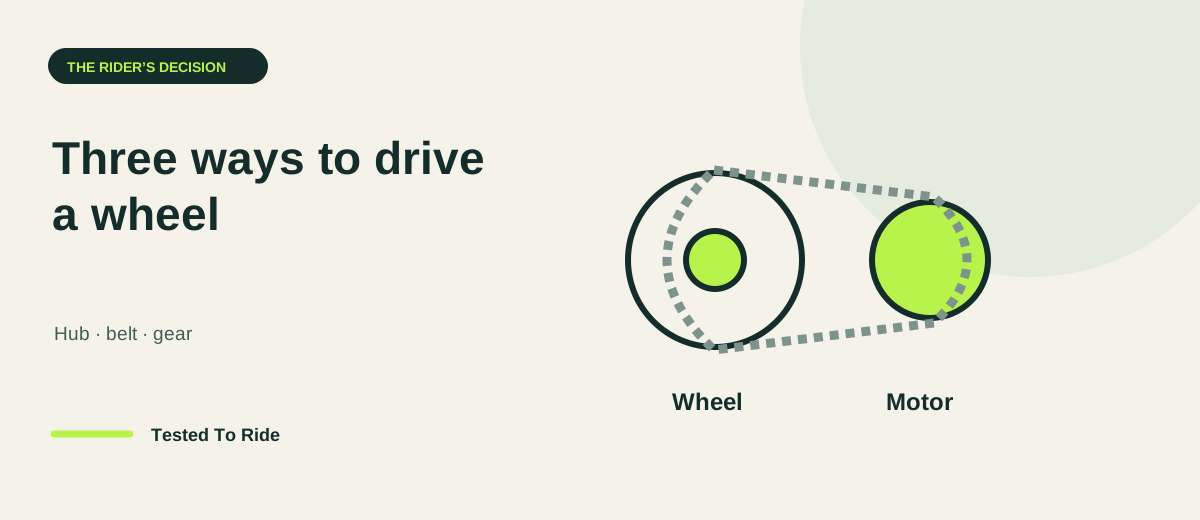
A belt platform connects a separate motor to a wheel pulley. This creates more wheel-system choices when the correct pulley, bearings and clearances are supported. It also introduces belt dimensions, alignment and tension into the service plan.
For the current Ultra Belt, the manufacturer names a 5M 265 belt and a 40T Kegel pulley. Confirm width and exact replacement SKU before ordering; those names are not a universal specification for every Tynee or belt board. A supplied spare is useful only if it matches the assembly you will service.
Gear drive: check the service arrangement
A geared platform changes the transmission and the work required to support it. The X2 and current Nomad variants need their own maintenance instructions, couplers and parts. Do not treat enclosed hardware as proof that it will never require inspection or service.
Before paying for the system, establish whether routine work is owner-serviceable, which tools and consumables are required, and where more involved service happens. A premium can be justified by a preferred supported platform; nominal battery capacity alone does not explain the price difference.
Named examples keep drivetrain advice practical
The Ultra Hub base and Ultra Belt both list 8.6kg, yet their selected packs are 216Wh and 374.4Wh. That comparison shows why a hub-versus-belt verdict cannot be made from mass or battery alone. The parts and supported wheel systems differ, and those differences need an ownership reason.
The X2 introduces a gear transmission and a 504Wh pack. Its disputed mass and load figures remain unresolved, so it is an example of a platform type rather than a fully settled alternative for every buyer. A clear service procedure matters more than assuming an enclosed mechanism needs no attention.
A direct-drive search should not silently be answered with gear drive. The terms describe different arrangements; this publication has not established an exact current US direct-drive winner. For a motor or conversion-kit purchase, the complete compatibility and electrical system would need its own research.
The ESC and remote are another part of the decision
A Hobbywing name identifies a controller supplier or system family, not one universal control tune. Compare the exact board, ESC revision, remote and firmware. Two boards using the same supplier may still have different settings, limits and replacement requirements.
Likewise, smoothness, braking response and acceleration need relevant observations or measurements. I would not turn a controller brand into an unqualified ride-quality award. Read the remote instructions and establish the supported pairing and warning behaviour for the delivered setup.
For upkeep, ask a focused question: which component wears in normal use, how is it inspected and what exact part replaces it? The answer is a sleeve or assembly for one system, a complete belt/pulley specification for another and a model-specific service procedure for a gear platform.
Compare power claims on the same basis
Peak, nominal and continuous output are different descriptions. Adding two advertised motor numbers does not establish measured acceleration, climbing or braking. Battery, gearing, current limits, wheels, load and operating conditions also matter.
Likewise, equal watt-hours across drivetrains do not guarantee equal range. Keep each manufacturer claim attached to its configuration. Choose among systems using a relevant documented ride comparison when available, rather than infer a percentage advantage from the drive label.
Use a replacement checklist
For a hub system, identify the driven sleeves and motor assemblies. For belts, identify the belt profile/length/width, pulley standard and supported wheel setup. For gears, identify the exact revision, service instructions and parts route. All three still need wheel, bearing, truck, deck and electrical-system checks.
I would choose the supported system that fits the desired wheels and realistic service routine. The Ultra Hub versus Ultra Belt comparison shows how that decision interacts with pack capacity and carrying mass on two specific configurations.
Questions about this task
Is belt drive always faster?
No. Belt drive is not automatically faster than hub or gear drive. The actual battery, gearing, wheels and controller limits determine the configuration being compared. A drive label alone cannot establish speed under load.
Which drive would I choose for low maintenance?
I would start with hub drive for a street buyer who wants no exposed belts to inspect or replace. It still needs compatible driven sleeves and normal board care. Belt and gear systems can suit other priorities, but neither removes the need for its own upkeep plan.