

Tynee Mini 3 SL
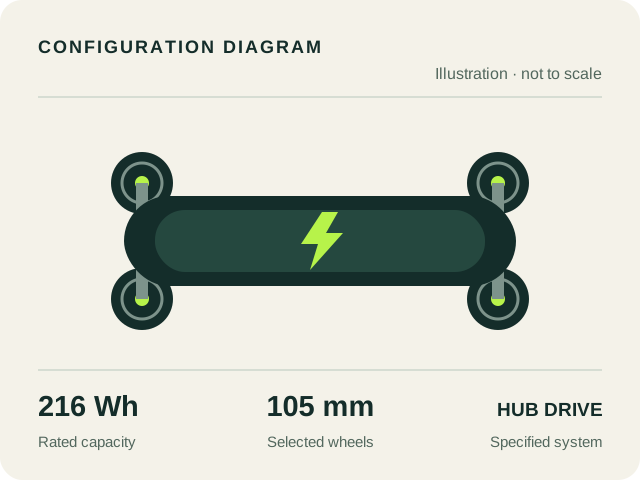
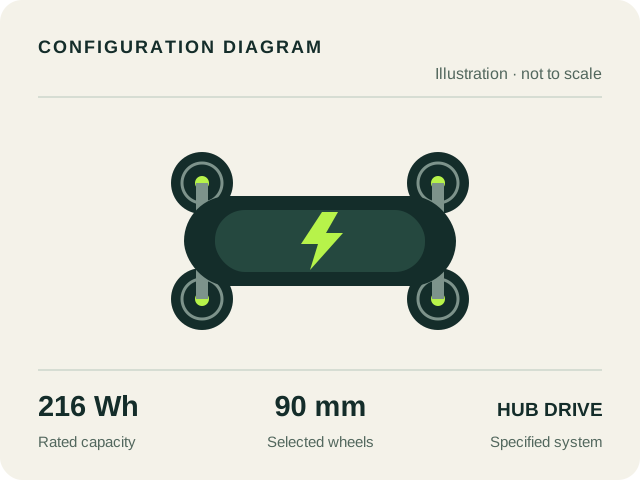
Its compact footprint is the reason to shortlist it for desk or train storage. Judge the remaining carry separately, because the listed mass is still substantial.
216Wh · 90mm wheels · six-month base warranty
Exway Wave
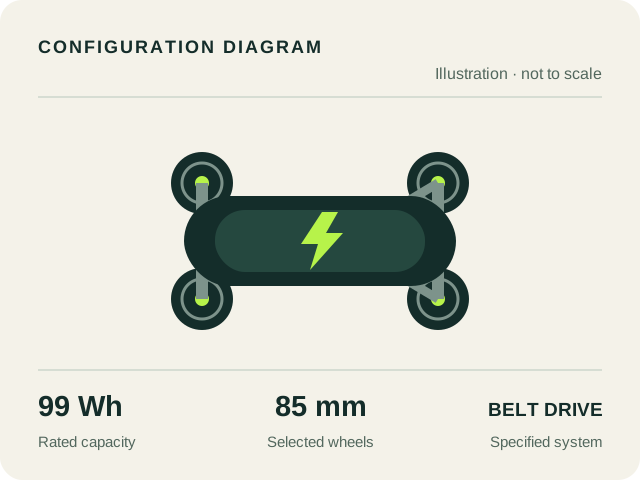
Consider it for a short trip with an inconvenient board-charging location. Verify the 99Wh pack, spare supply and compatible charger before building the commute around swapping.
Belt · 99Wh Air · 85mm baseline
The tradeoff, made visible
Explore the specification tradeoffs
- Tynee Ultra Hub216 Wh
- Backfire G2 Black187 Wh
- Tynee Mini 3 SL216 Wh
- Exway Wave99 Wh
Rated battery capacity in watt-hours. Stored energy is not a measured distance or a prediction of range.
Write a route card
Record the round trip, likely detours, steepest section, surface changes and every place you must carry. Separate the route you want to ride from the sections where riding is actually allowed. Check the relevant road, campus, employer and transit rules directly; a US-market board is not permission to use every US path.
Walk the least familiar section before relying on it. Broken pavement, a narrow crossing or a wet underpass can decide the transport plan even when most of the route looks straightforward. A backup option belongs in an essential commute, particularly while you are learning the route and battery consumption.
What a 15km commute actually requires
First decide whether 15km describes one direction or the entire day. A 15km round trip is about 9.3 miles before detours and reserve. A 15km one-way trip becomes 30km, about 18.6 miles, if you must return without charging. Confusing those descriptions can double the transport requirement.
As an illustrative plan, a 15km one-way journey ridden twice, plus 2km of detours and a personally chosen 5km reserve, gives a 37km requirement. Those added distances are example inputs, not a recommended universal reserve. Use the trip calculator with your own distances. It calculates the requirement and does not decide which board will achieve it.
I would not rely on the base Hub’s manufacturer range claim to approve the 30km return scenario. The larger pack deserves comparison, but it still needs relevant riding information and a backup. Destination charging only changes that calculation when the location permits it, the correct charger is available and the charge fits the day.
Three commuting problems, three different choices
For a suitable mostly continuous street route with storage at both ends, compare the Ultra Hub’s two packs before adding specialist hardware. For repeated steps or station transfers, examine net board mass and how the lift will work; the G2 Black is lighter on its published figure, while the Mini changes storage dimensions more than it reduces weight.
If the board cannot sit near a socket, investigate the Wave’s removable battery workflow. Obtain the exact spare-pack price and charging arrangement first. Carrying another pack may solve charging access while creating a new weight and storage problem. The selected Wave is a 99Wh Belt configuration, not a larger-pack claim borrowed from the family.
College, city streets and mixed transport
For a campus rider, the last part of the journey may be indoors: lecture-room storage, stairs and rules for battery-powered equipment. Ask the institution about both riding and bringing the board inside. A compact board can be easier to fit beside a desk while still being an awkward 8kg-plus object to lift.
A city label, including New York, does not define a legal route or a consistent pavement surface. Check the actual jurisdiction and property rules for each section. I would map the dismount points, station transfer and fallback first, then choose between the longboard and compact options.
Daily downtime deserves a purchase question of its own: who supplies a matching remote, charger or driven sleeve, and where does a faulty board go? For a necessary commute, I would favour a clear parts route over an optional feature that adds another proprietary component.
Plan the return journey as well
Use the distance you must finish and a reserve for your actual conditions. Longer routes can change speed, load and weather, and the last advertised mile is a poor basis for an essential arrival. Compare a relevant exact-model riding record when available; a capacity comparison helps narrow options but does not predict a guaranteed commute.
A rated 345.6Wh pack stores 60% more nominal energy than 216Wh. That arithmetic does not establish 60% more miles on your journey. See the range planning guide for a route worksheet that keeps the assumptions visible.
Choose a charging workflow you can actually use
With the Ultra Hub, G2 or Mini, plan to bring the whole board to an approved charging location. The Wave’s removable pack can change that routine, but the selected 99Wh kit still needs its included charger and generation confirmed. A removable battery is useful only when the destination permits it and an attended charging arrangement is practical.
For a route with no charging access, calculate the complete return distance first in the trip planner. For regular stairs, compare the G2’s listed 7.6kg / 16.8lb with the base Mini’s 8.15kg / 18.0lb: shorter does not mean lighter. For storage, use overall dimensions and allow clearance for the wheels and cable.
Choose a dry-route fallback
A water-resistance label addresses a different question from grip, braking or water-damage coverage. A board should not become your only way home when conditions exceed its instructions. The rain and water guide explains why a promising IP headline cannot settle that decision.
Before ordering, compare the complete kit, seller and replacement access against the disruption you can tolerate. A spare remote that is difficult to obtain can matter more to a commuting buyer than another advertised mile per hour.
Compare the commute and carrying tradeoffs
| Board | Selected kit | Rated capacity | Listed board mass | Commute constraint | Amazon |
|---|---|---|---|---|---|
| Tynee Ultra Hub | 216Wh · 105mm donut wheels · six-month base warranty | 216 Wh | 8.6 kg / 19.0 lb | Full-length board; 105mm wheels. Whole-board charging; larger battery is a separate order. | Find on Amazon Search results; this exact kit is not verified on Amazon. |
| Backfire G2 Black | G2 Black · 187Wh · 96mm wheels · hub drive | 187 Wh | 7.6 kg / 16.8 lb | Listed 7.6kg / 16.8lb. Whole-board charging; 970 × 230mm is deck size, not overall footprint. | Buy on Amazon G2 Black / R5s listing; confirm seller, condition and checkout. |
| Tynee Mini 3 SL | 216Wh · 90mm wheels · six-month base warranty | 216 Wh | 8.15 kg / 18.0 lb | Overall 760 × 289 × 149mm (29.9 × 11.4 × 5.9in). Whole-board charging. | Find on Amazon Search results; this exact kit is not verified on Amazon. |
| Exway Wave | Belt · 99Wh Air · 85mm baseline | 99 Wh | Current 99Wh kit mass unconfirmed | 99Wh removable pack. Exact selected mass and included charger specification unresolved. | Find on Amazon Search results; this exact kit is not verified on Amazon. |
Questions about this shortlist
What is my first choice if I never carry the board?
I would choose the Ultra Hub for a suitable dry street commute with secure storage at both ends. Compare its 216Wh and 345.6Wh options against the complete return trip, detours and reserve. A shorter deck offers little advantage if storage and carrying are already resolved.
When is a removable battery worth the compromise?
A removable battery is worth it when the board cannot reach a suitable charging point but an approved removed pack can. The Wave is the compact option to investigate for that routine. Confirm the required charger and replacement-pack supply before paying the premium.