

Exway Wave
The removable pack is worth investigating if the board cannot reach a socket. Get written confirmation for the selected kit’s mass and replacement battery before making portability the deciding claim.
Belt · 99Wh Air · 85mm baseline
The tradeoff, made visible
Explore the specification tradeoffs
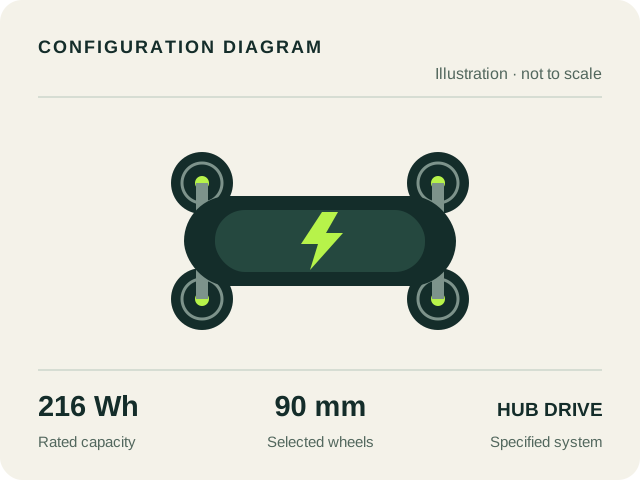
- Tynee Mini 3 SL216 Wh
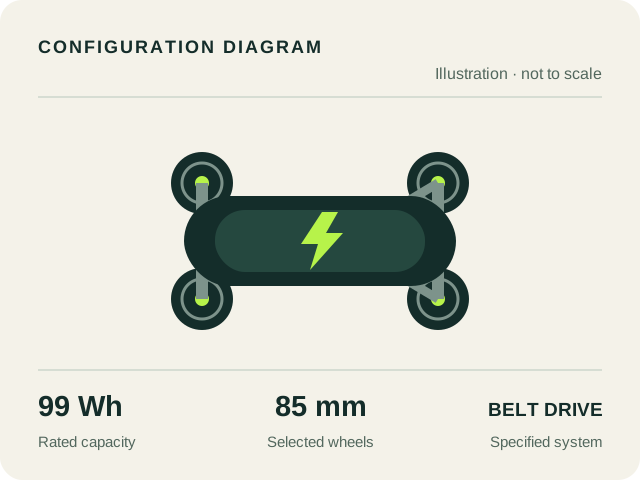
- Exway Wave99 Wh
Rated battery capacity in watt-hours. Stored energy is not a measured distance or a prediction of range.
Measure the space that creates the requirement
Write down the length, width and clearance available under the desk, beside the door or at a transit seat. Include protruding wheels and trucks. A deck length is only one part of the footprint, and a smaller board still needs a suitable place for its charger and protection.
The Mini 3 SL’s manufacturer lists overall dimensions of 760 × 289 × 149mm, a 752 × 235mm deck and a 556mm wheelbase. Each describes a different fit question. None measures how much usable standing room a particular rider will find comfortable.
Two Mini configurations, two different compromises
The Mini 3 SL base combines 216Wh and 90mm wheels at a listed 8.15kg. The larger selection combines 345.6Wh and 105mm wheels at 9.2kg. That adds 1.05kg, not just battery energy: wheel size changes too. Do not attribute the larger configuration’s capacity or weight to the base order.
Its overall 760mm length is approximately 29.9 inches, and 289mm width is about 11.4 inches. These conversions can help measure a US cupboard or shelf. Allow for the actual orientation, exposed wheels and a secure placement; they are not a claim that the board fits a particular bag.
Names such as mini, short, small, penny-style and portable describe overlapping shopping questions. They do not establish identical geometry. The named configurations below make those differences explicit; do not transfer a family’s lightest weight to its largest battery option.
Keep dimensions and carrying weight separate
The base Mini is listed at 8.15kg. That is only 0.45kg below the base Ultra Hub, despite a much shorter deck. For a long carry, I would compare the full-length alternatives as well; for a tight cupboard, the smaller footprint can remain the decisive benefit.
The Wave page contains differing mass figures and family specifications. The selected Belt/99Wh kit needs its own net weight confirmed. Do not turn a family headline or battery-module mass into a verified whole-board carrying figure.
Capacity or battery removal?
Mini’s base pack is rated 216Wh, while the selected Wave uses 99Wh. The nominal energy difference is clear, but it cannot establish a proportional riding-distance result across the two platforms. The Wave’s reason to stay on the list is its removable-pack workflow, which deserves checking against how you charge and carry.
A second battery also needs a suitable storage location, approved charger and realistic replacement supply. An airline-friendly product description is not an approval for your flight or route. Confirm the carrier and battery/device rules directly before planning air travel.
The best swappable battery choice depends on the replacement workflow
The Wave is the defined removable-pack alternative in this compact comparison. Before buying, ask whether the selected 99Wh Air pack is available as a replacement, which charger is approved and whether charging a removed pack requires a separate accessory. Do not assume that any advertised spare battery includes the equipment needed to use it.
A spare is useful only if it can be transported and stored under the manufacturer’s instructions. If it stays at work, record how it will be charged there. If it travels with you, count its weight and the extra handling. Neither routine turns a single installed 99Wh module into a larger battery.
I would favour the integrated Mini when the board reaches the socket and the base pack suits the route. I would favour a fully verified Wave workflow when separating board and battery removes a genuine daily obstacle. That is a practical buying recommendation, rather than a range or carrying award from conflicting family figures.
Choose the problem you need solved
Choose the Mini path when a compact storage envelope and an integrated board routine fit you. Choose the Wave path when taking the battery to a suitable charging point changes whether the board is practical at all. Reconsider both if the main requirement is the lowest carrying load with no storage constraint.
The Mini 3 SL versus Wave comparison focuses on that capacity-versus-workflow choice. For a first purchase, use the beginner guide as well; a short deck is not an automatic learning advantage.
MEEPO Mini 5 or Mini 3 Max?
The MEEPO Mini 5 is a separate 144Wh/90mm hub board, manufacturer-listed at 7.9kg, approximately 17.4lb. Its 762 × 235mm figure describes the deck, not the full storage envelope. The box list says M5 remote while the specifications say M6C, so the delivered control revision remains a buying check.
The Mini 3 Max raises rated capacity to 324Wh with 90mm wheels. That is 2.25 times the Mini 5’s nominal energy; it is not 2.25 times measured range. Its page conflicts between 8.0kg and 8.8kg and between 762mm and 765mm deck length. I’d investigate it for a compact longer-route brief, but would resolve those dimensions and the actual retailer kit before treating it as the lighter alternative.
Cyber Mini is four different configurations
Maxfind’s Cyber Mini Air is the 99Wh single-hub option at a listed 5.6kg / 12.3lb. The ordinary Cyber Mini is a dual-hub 158.4Wh board at 7.3kg / 16.1lb. Both use 90mm wheels and share the listed 835 × 270 × 160mm overall envelope, about 32.9 × 10.6 × 6.3 inches.
The Pro changes to belt drive, 346Wh and 107mm wheels at 8.5kg / 18.7lb. The X is another belt configuration with 415Wh at 9.2kg / 20.3lb. Their listed width grows to 305mm, about 12 inches. Air’s low weight cannot describe Pro or X. I’d shortlist Air for carrying only after confirming the route and seller’s kit; its 99Wh label alone does not establish airline permission. A battery-size comparison belongs with the route requirement, not a borrowed family range headline.
Compare the space and charging requirements
| Board | Selected kit | Rated capacity | Listed board mass | Storage / battery workflow | Amazon |
|---|---|---|---|---|---|
| Tynee Mini 3 SL | 216Wh · 90mm wheels · six-month base warranty | 216 Wh | 8.15 kg / 18.0 lb | Overall 760 × 289 × 149mm (29.9 × 11.4 × 5.9in); deck 752 × 235mm; integrated pack. | Find on Amazon Search results; this exact kit is not verified on Amazon. |
| Exway Wave | Belt · 99Wh Air · 85mm baseline | 99 Wh | Current 99Wh kit mass unconfirmed | 99Wh removable battery; 180Wh and other generations are different kits. Exact overall envelope and charger require confirmation. | Find on Amazon Search results; this exact kit is not verified on Amazon. |
Questions about this shortlist
What is the lightweight pick here?
The G2 Black has the lower verified manufacturer mass if carrying matters more than compact storage: 7.6kg versus the base Mini 3 SL’s 8.15kg. The selected Wave’s assembled mass remains unresolved, so I would not award it the carrying win.
Does 99Wh mean I can take the Wave on a plane?
No. The Wave’s 99Wh Air label does not establish airline acceptance. Ask your carrier about the exact board and battery on your booked route before making a travel purchase.