

What the published support terms actually cover
A warranty period, a return window and a wear-part policy answer different questions. These manufacturer-store terms establish a useful starting comparison; the Amazon seller’s terms and eligibility still control the order you make.
- Backfire US
- 180 days for boards and 90 days for separate parts. Direct-store 30-day returns require new condition and original contents; the buyer pays return freight.
- Tynee
- Six months for the base Ultra order, 12 months for Explorer and three months for parts. Covered defective parts are free, but the customer pays shipping. Standard wear items and the deck are excluded.
- WowGo
- The 2S MAX product page advertises 270 days while the policy says 180; separate parts get 90 days. Covered parts/shipping are described as free, but the applicable duration still needs written confirmation.
- MEEPO
- Ordinary boards including V5 have six-month coverage; specified premium models differ. Parts have three months. Original-buyer proof is required; wear and water damage are excluded.
- Exway
- Wave coverage is six months from receipt. The direct-store unopened-return request window is seven days; own-reason returns can lose a 5% fee plus freight.
This comparison does not measure response speed, failure rates or how a disputed claim will be handled. Preserve the terms attached to the actual purchase, especially where the product page and policy disagree.
Parts availability is a more useful question than prestige
The selected Ultra Belt has a resolved replacement-belt size and quantity, while the 105mm Ultra Hub needs its matching wheel system. Explorer adds tyres and tubes to the drive consumables. The priced replacement baskets show precisely what each optional stock purchase contains, rather than turn an unknown lifespan into an annual running-cost claim.
I would give more weight to a correctly identified, obtainable part than to a generic promise of maintenance-free ownership. A part listed for the wrong wheel size or battery generation does not rescue the service plan, even when it is cheaper. Price shipping separately: a small item can have a different delivered cost from the board.
Tynee: keep options and shipping obligations together
The Ultra family spans hub, belt and higher-voltage X Pro configurations; a shared name does not make the batteries, chargers or wear parts interchangeable. The store also sells warranty selections that change price. Identify the chosen base or extended coverage beside the kit.
Tynee’s warranty policy excludes wear items and describes customer-paid shipping for replacement accessories. Those terms belong beside any coverage period. I would confirm the exact battery warranty and parts route before paying for an extension.
WowGo and Backfire: use the current documents
WowGo’s 2S MAX product/policy warranty disagreement deserves a written answer for the order. Its net/gross weight distinction and separate wheel packages also matter when comparing a cheap street purchase. A factory-test statement is a manufacturer claim, not Leonard’s experience or a measured failure rate.
Backfire provides an official board/remote manual index and a US warranty page. That is useful documentation access, but the S3/X2 specification conflicts still need resolving. G2 Black and G2Z are different drives even when sold on the same family page.
Exway, MEEPO and specialist platforms
Exway’s manual/app index distinguishes hardware generations, and its policy describes different coverage by product and purchase circumstances. Check the actual Wave, Atlas or other revision instead of transferring an app or charger feature across the range. For the V5, MEEPO identifies an M6C remote, but an Amazon search result still needs its battery, controller and seller support matched to the offered kit.
Maxfind’s current A802/A805/A803/A804 selections change the pack or drive. Acedeck’s current-generation Nomad builds need exact batch and service confirmation. Ownboard wheel/cell kits change the purchase being compared. Evolve’s current service terms make shipping, labour and accessory coverage relevant beyond the headline board period.
What would justify a reliability ranking?
A meaningful failure-rate comparison would need a defined population, comparable model age, usage and reporting method. A set of enthusiastic posts, a long warranty headline or a high sales rank does not supply that dataset. I would not turn those signals into percentages or a best-brand reliability score.
Owner accounts can still identify questions to investigate: a repeated part name, an unclear return route or a compatibility dispute. Match the exact revision, retain attribution where a finding is used and verify any product fact independently. An uncredited experience should not become Leonard’s test.
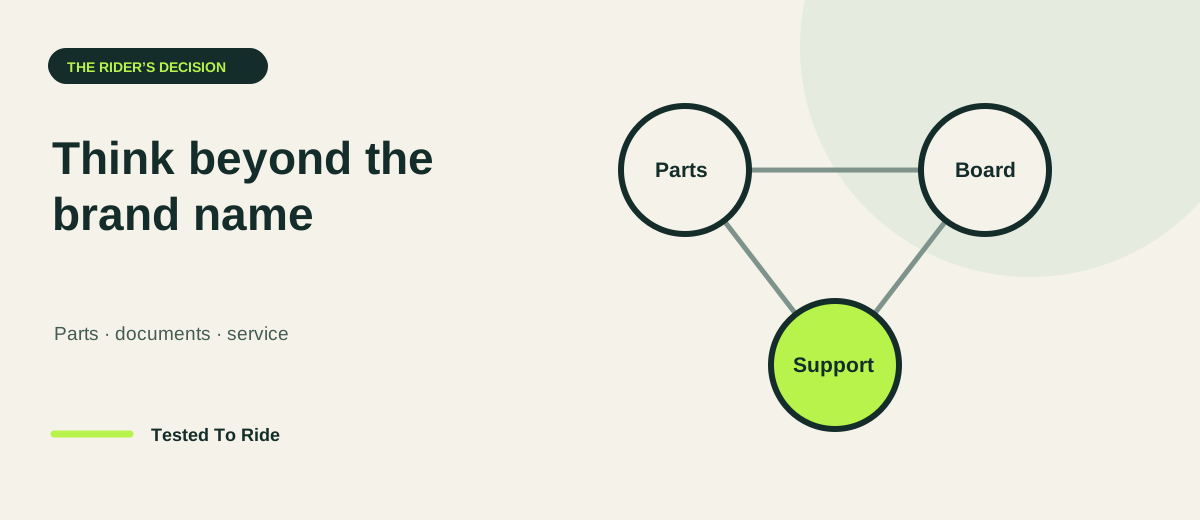
For the actual purchase, narrow by the board that fits first, then assess its support arrangement. The buying guides compare rider needs; the brand page makes the post-purchase checks concrete. That division keeps a generic brand ranking from repeating every product assessment.
What these records can establish
A policy can establish a stated promise or exclusion. A parts listing can identify a supported item. An owner report can describe a particular interaction. None of those alone establishes a brand-wide failure rate or guarantees how your case will be handled.
I would choose the complete board-and-support arrangement that fits the budget and disruption I can tolerate. The maintenance checklist turns that decision into a specific replacement plan, and the affiliate disclosure explains the publication’s shopping links.
What does SE Dragon refer to?
In electric-skateboard shopping, SE Dragon usually points to Skateboards Electric’s SE1 Dragon family. Standard and XL9 versions have different deck and overall lengths, and current 16S battery choices must not inherit older 14S instructions. The maker’s selected configurations use proprietary truck and drivetrain arrangements that warrant their own service plan.
The listing and linked manual disagree on some tyre and length figures; manual weights are not tied to each current battery option. I would resolve the delivered build before recommending one. A broad phrase such as “dragon electric” is not enough to identify a board, a charger or a usable replacement part.
Resolve Maxfind model names before comparing prices
“Maxfind Max” is incomplete: MAX ONE, MAX2 PRO and CYBER MAX are different families. MAX ONE is primarily marketed to children and is not automatically a suitable adult budget choice. All selectable MAX2 PRO variants in the checked manufacturer catalogue are labelled Canada-only; those regional offers cannot establish an available US budget recommendation.
The identified Cyber Max configuration remains in the main guide. For short-deck choices, use the four Cyber Mini configurations instead of combining the cheapest family price, lightest mass and largest-pack performance claim.
Questions about brands and support
Does a US warehouse prove US service?
No. A US warehouse identifies a dispatch option, not the location of every repair or spare. Ask who handles your seller’s warranty, where parts or the board must go, and which shipping costs you pay.
Would I choose a longer warranty automatically?
No. I would compare battery coverage, wear exclusions, eligibility and shipping obligations before the stated period. A longer warranty only adds value when its actual terms and service route suit the purchase.