

The tradeoff, made visible
Explore the specification tradeoffs
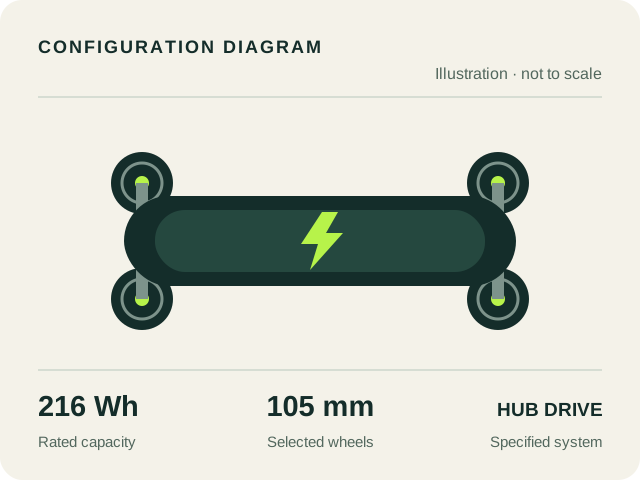
- Tynee Ultra Hub216 Wh
- WowGo 2S MAX216 Wh
- Backfire Zealot S3403 Wh
- Backfire Zealot X2504 Wh
Rated battery capacity in watt-hours. Stored energy is not a measured distance or a prediction of range.
Weigh the load the manufacturer asks you to count
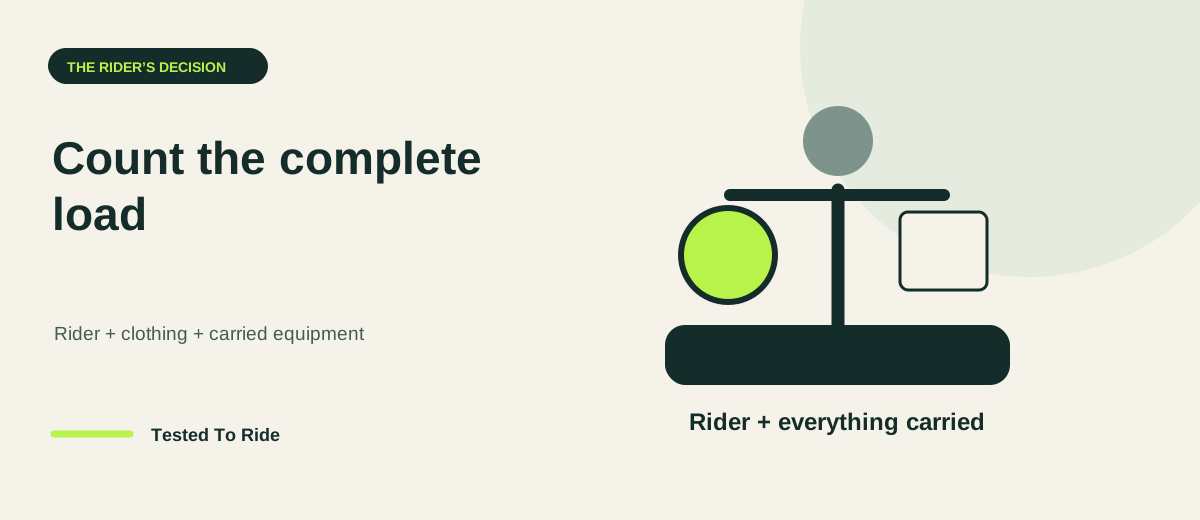
Record body weight and the backpack, protection or equipment carried. Ask the manufacturer whether its stated limit applies to rider weight alone or the full carried load. Keep the basis and units with the number; do not switch between them to make a borderline purchase appear suitable.
If the combined requirement exceeds the applicable limit, choose another platform or transport plan. If it approaches the limit, seek relevant exact-setup riding information and written clarification rather than invent a universal safety margin. No percentage below the label guarantees a suitable ride.
Calculate the load before making the shortlist
For example, a 112kg rider carrying an 8kg bag already reaches 120kg before any other equipment that the applicable limit includes. That is an arithmetic example, not a prediction of how a board handles the load. It also shows why a rider-only question and an all-up requirement can produce different shopping answers.
Do not subtract an invented safety percentage from a maximum and present the result as manufacturer guidance. Ask what the published limit means and whether the current board is appropriate for the actual load, gradients and braking demands. Being below a printed maximum is necessary where that maximum applies; it does not establish satisfactory performance.
I would also request the usable deck area and stance information rather than judge fit from overall board length. On the Ultra Hub, the 966 × 222mm listed deck and 807mm wheelbase describe the physical configuration. They do not replace standing on a suitable demonstrator where a genuine opportunity exists.
Separate a clear statement from a conflict
Tynee’s Ultra Hub specification lists 150kg. For the WowGo 2S MAX, the specification gives 150kg/330lb, but the same product FAQ recommends a maximum rider weight of 120kg/264lb. I would use that lower recommendation in a buying discussion and ask WowGo to clarify the limit and what carried equipment it includes.
The S3 and X2 listings state 120kg, while their linked manuals state 110kg. A buyer who needs the higher figure should obtain the document governing the delivered revision. Until then, those boards do not provide a resolved answer to that load requirement.
Assess stance and route together
Look at usable deck space, wheelbase and the actual standing position, as well as the outside dimensions. Deck materials or a flex description cannot determine how comfortable a specific load will feel. The wheel and truck setup also belongs in the comparison.
For a hilly essential route, a motor-watt total is insufficient. Ask about the board’s operating limits, battery state restrictions and relevant performance information for a comparable load. A pneumatic platform may add a different set of tyre, carrying and service requirements rather than solve every road problem.
My conditions for a positive shortlist
I would keep the Ultra Hub and 2S MAX in a manufacturer-specification comparison when the applicable confirmed load comfortably accommodates the buyer’s actual requirements. I would still settle route permission, deck fit, replacement supply and return terms. There is no named-model firsthand heavy-rider comparison in the current record.
Boards with unclear current battery or mass information need additional investigation before carrying recommendations. That applies to specialist alternatives too; a premium price is not evidence that every limit is better documented.
Send a precise question before ordering
Identify the selected model, battery, wheels, regional order and rider-plus-equipment load. Ask which current manual governs it, what the stated load includes and whether the intended route falls within its operating instructions. Retain the written answer with the purchase information.
Use the first-board checklist to complete the rest of the brief. Load compatibility is one necessary check in a buying decision, not a replacement for all the others.
When I would keep the Ultra Hub, and when I would walk away
I would retain the Hub when its confirmed load basis accommodates the complete requirement, the deck arrangement suits the rider and the intended street route fits the instructions. The 345.6Wh option may be worth comparing for a longer route, but the extra energy is not proof of improved braking or hill control.
I would walk away from a purchase that depends on an unresolved higher limit, a vague claim that the motors are powerful enough or a seller who cannot identify the actual manual. A more expensive specialist board needs the same checks. Tyres and extra motors do not erase a stated limit.
If the requirement is close to a threshold, put it in writing to the manufacturer before ordering and ask what return or assessment route is available. The brand and support guide helps judge the answer without turning a warranty headline into a performance guarantee.
Compare load statements before choosing
| Board | Selected kit | Rated capacity | Listed board mass | Published load basis | Amazon |
|---|---|---|---|---|---|
| Tynee Ultra Hub | 216Wh · 105mm donut wheels · six-month base warranty | 216 Wh | 8.6 kg / 19.0 lb | 150kg / about 331lb maker maximum; clarify rider versus combined carried load for the order. | Find on Amazon Search results; this exact kit is not verified on Amazon. |
| WowGo 2S MAX | 90mm · 216Wh · selected US warehouse | 216 Wh | 8.2 kg / 18.1 lb | 150kg / 330lb stated maximum; product FAQ recommends riders at or below 120kg / 264lb. | Find on Amazon Search results; this exact kit is not verified on Amazon. |
| Backfire Zealot S3 | US S3 · 403Wh · 96mm · Major V3 remote | 403 Wh | 10.5/10.7kg (23.1/23.6lb) conflict | Listing 120kg / about 265lb; official manual 110kg / about 243lb. Revision conflict unresolved. | Find on Amazon Search results; this exact kit is not verified on Amazon. |
| Backfire Zealot X2 | US X2 · 504Wh · 105mm · gear drive | 504 Wh | Official figures conflict | Listing 120kg / about 265lb; official manual 110kg / about 243lb. Revision conflict unresolved. | Find on Amazon Search results; this exact kit is not verified on Amazon. |
Questions about this shortlist
Is 330lb a universal recommendation for the 2S MAX?
No. WowGo lists 330lb/150kg maximum load but also recommends a 264lb/120kg maximum rider weight in its FAQ. Use the lower recommendation in your buying discussion and obtain clarification for your exact configuration and carried load.
Does higher motor wattage prove suitability for a heavier rider?
No. Higher wattage does not prove an appropriate load limit, deck fit, hill performance or braking at that weight. Confirm the applicable instructions and relevant exact-setup performance information. Peak and nominal motor figures describe different quantities.